
History of radio in Cresco
Wed, 03/23/2022 - 5:20pm
admin

By:
Marcie Klomp ~ News Editor tpdeditor@crescotimes.com
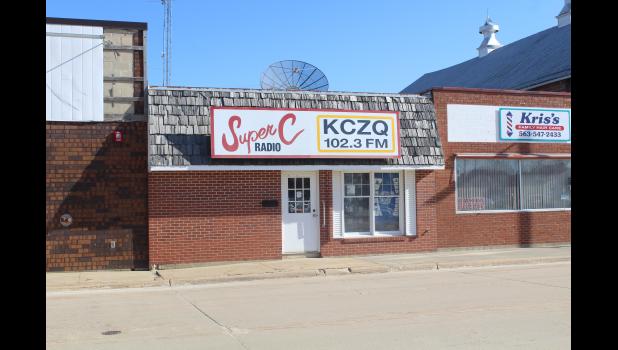
CRESCO - A year ago, Super C (102.3 Radio) celebrated its 30th year on the air.
Believe it or not, KCZQ wasn’t the first radio station, or the second, in Cresco. It wasn’t even the third!
The first record of an AM radio station is mentioned on the website https://jeff560.tripod.com/chrono1.html.
WNAG was authorized in September 1922, but there is no mention of it in the Times Plain Dealer’s archives. Another website, https://earlyradiohistory.us stated it was deleted just a few months later, in January 1923.
Besides that short run, there was a second radio station in 1926-1927 and a remote studio in the early 1960s!
DAJY/KGDJ On Air
Raymond “Red” Rathert ran a radio shop in what is now the empty spot between the Cresco Theatre & Opera House and Atomic Pizza. He also constructed a radio station in early October 1926, running it from his home for awhile under the amateur call letters of DAJY.
In November, the call letters of KGDJ were authorized. Its frequency was 1,480, power (Watts) of 10 and wave (meters) of 202.6. Later the station was located in the Theatre and was only around for less than two years.
The studio was located over the lobby and directly under the back portion of the balcony. The area is now the costume department.
An article in the Dec. 10, 1926 Cresco Plain Dealer stated a partition segregating the operating room from the studio was erected, and all broadcasting apparatus was installed. Mr. Rathert built a total of five microphones for the station.
Heavy draperies were installed between the operating room and studio, providing a dead air space of several feet.
Local businessmen contributed to the radio station. F.C. Hinds gave the studio and maintenance; F.B. Lowry furnished paint; Thomas Darby contributed the draperies; and Baldwin Piano Co. donated a piano by agent A.D. Patterson.
Rathert was the radio technician and operator; L.R. Fields, an insuranceman, was announcer; Glen Woodard was studio superintendent; Norman Bradley, furniture/undertaker, was program director; Fred Hinds was in charge of publicity; and George Church was the telephone operator. The Dec. 31 Plain Dealer reported, “The only difference between these workers and the dollar-a-year men of the war are that the war workers received 100 cents more salary per year than the studio staff.”
[Les Fields Sr. could have gotten his announcing gig by being a former Cresco High School teacher of public speaking. He later was a principal. Les Jr. of the Turkey River All Stars does not remember hearing much about his father being an announcer but learned he did minstrel show, put on by the American Legion.
Fields had picked up a steamer trunk when he was in France during WWI. The props from the shows were stored in the trunk. The younger Fields still has that trunk filled with wigs, paint and more.]
In early December, test programs had been aired and the reception was ideal. It was reported one program was heard in Chicago and the results of a football game were heard in Minneapolis.
Up until the end of December 1926, only intermittent broadcasts had been given. But the plan was to have set times for being on the air. This included Monday and Friday night concerts by local talent at 10 and daily market reports at 11:45 a.m.
The previous Sunday afternoon, the Assumption Church choir held a concert. It was supposed to be for just half-an-hour, but 45 phone call requests later the choir had played for two hours. Calls came from Cresco, Bonair, Lime Springs, Ridgeway, Protivin, Harmony and even McGregor.
On Christmas Eve and Christmas Day, Deane’s Blackhawk Orchestra was another splendid program.
In February 1927, members of the State Theatre Kiddies’ Revue of Minneapolis performed at the opera house and then broadcast on KGDJ, courtesy of Cresco Union Savings Bank. Sponsors for other programs included Bents Nursery, Cresco Creamery, McHugh and Lusson Implement Dealers, Willard Service Station of Cresco, Marsh Furniture Store and the American Legion.
During the program, C.C. Burgess, president of the Commercial Club, announced the only financial income of KGDJ was from sponsors, and that money didn’t go far. As a result of his plea, about $225 was received that evening, which was fortunate as the license fee was $200 per year for broadcasting popular music.
In March, a play-by-play of the final game of the basketball tournament was broadcast. Leon DeNoyelles gave the plays over a specially-leased telephone wire, and it was announced in an interesting manner by Fields, who was an old basketball coach.
Jack Flynn, a professional radio entertainer, even listened to KGDJ when he got a chance. He said it was the best small station he had ever heard.
KGDJ Off Air
The last mention of the station was in April 1927 when it was announced it had been granted a temporary license by the Federal Radio Commission, and was one of the 200 stations given a license. The article said, “It is thought there will be no difficulty in securing a permanent license when they are issued owing to our location and the wave length used, which does not interfere with other stations.”
One website shows that on Dec. 3 (either 1927 or 1929) it was deleted by the FCC. It could be that the license was not renewed.
KDEC On Air
It took another 36 years before another radio station was associated with Cresco.
KDEC in Decorah had a remote studio in Cresco that was located above the old Ben Franklin Store (now Leuthold’s Clothing Store) in 1963-64.
Jim Juve of Decorah recalled Luther College had the rights to the FCC station. “Verne Koenig and Ken Bjerke would take the signal during the week and let Luther have it at night and on weekends.”
Gary Peterson, a former news director at KAAL-TV in Austin, Minn., got his start in broadcasting right here in Howard County. He graduated from Cresco High School in 1959 and went into the Air Force. When he was discharged, he came back to his home town and started working at the local station. He worked with the late Dale Kaderabek.
“It was an interesting time,” Peterson said. “We started a little office above street level. I was the news guy and did fire and whatever else came up. We broadcast the stock car races. We set up at the fairgrounds, and our play-by-play was ‘Here they come. Here they go!’ We had a good time.”
At one point, Howard County Sheriff Percy Haven talked Peterson into being sworn in as Civil Defense Director. He was sworn in on Feb. 10, 1964. He got married and left town that fall, and on Nov. 2, James E. Goetsch was sworn in.
One of his most memorable moments in Cresco came on Nov. 22, 1963. “I was on the air when President John F. Kennedy was assassinated. I would get teletype to report.” He recalls he was in the Cresco Cafe two days later, a Sunday, when the news came on the television that Oswald had been shot and killed.
Peterson enjoyed his time in Howard County. “It was busy. There was an emphasis on Cresco news. I used to do record hops and other things.”
After KDEC, Peterson went to KOTE in Fergus Falls, Minn., then to Rochester for one-and-a-half years, then to KSTP in Minneapolis (which is a big operation) and back to Rochester as news director. “I like it there because I didn’t have to cover murders. It was nice.” Peterson said he was in radio until about 1975 and then went into television.
[As a side note, Peterson met and interviewed some famous individuals, including Walter Mondale and Hubert Humphrey (U.S. Vice-President, 1965-1969). He recalled having coffee with Humphrey, who went to the restroom. He came out chuckling. peterson asked what was so funny. It turns out, Humphrey put a sign on the hand dryer that said, “For a speech by Hubert Humphrey, press here!”]
KDEC Off Air
According to a few old Times Plain Dealer articles, Notre Dame and Crestwood High Schools reported school news on KDEC starting in 1962. The speech students took turns either giving school announcements or an editorial comment on what was happening.
In the Nov. 25, 1964 Lime Springs Herald, a Letter to the Editor from the speech class implored the citizens and businessmen of the area to recognize the value of a radio station and encourage it. “We are sorry to hear that Cresco no longer has a radio station. In view of the fact that Cresco has the desire to become an industrial community, it should be necessary to hav at least a two-hour broadcast of new sand entertainment in its own studio.
“The Crestwood High School speech class has been giving Crestwood news and editorial comments every Wednesday afternoon at 1:00 at the local KDEC studio. this opportunity is a valuable experience for all of us. It is especially important to speak live rather than resorting to taping our reports to be played later because much of the tension is gone when we know that what we are saying is not going out over the air the moment we speak — we need practice in speaking under tension, when corrections can no longer be made.”
KDEC in Decorah continued to air news from Notre Dame High School students until at least November 1969.
KCZQ On Air
The remote studio for KDEC in Cresco was discontinued in fall 1964. It was another 27 years before KCZQ, Super C radio was established, and it has been going strong for over 30 years. It celebrated its anniversary on April 1, 2021.
